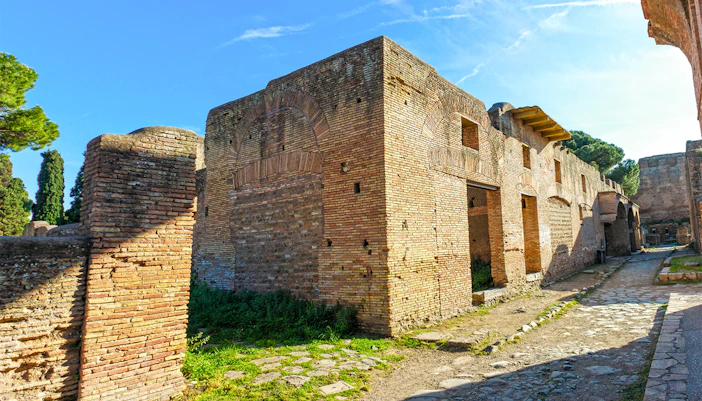
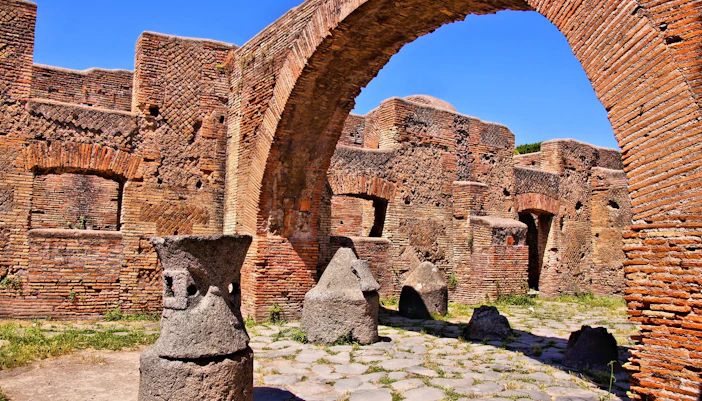
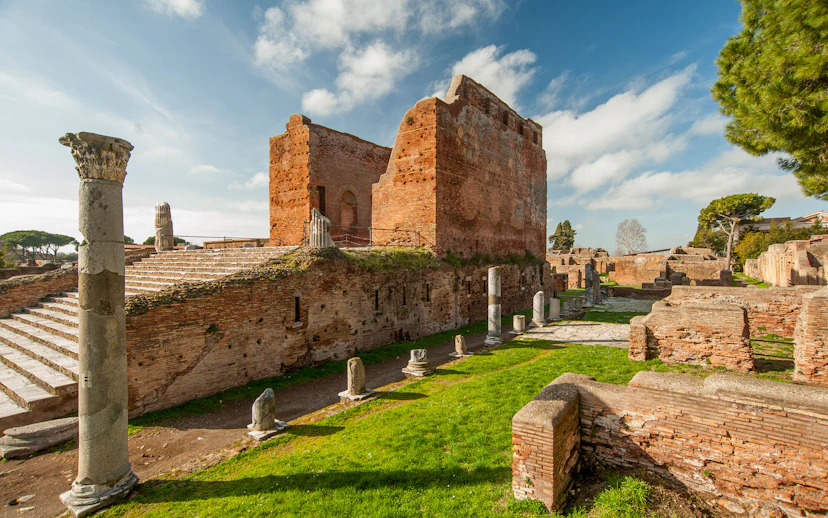
Ostia Antica is Rome’s ancient port city, best known for its remarkably intact streets, bath mosaics, theater, and apartment blocks. This is not a quick monument stop — it’s a large open-air site where even a short visit means steady walking on uneven Roman paving. The biggest difference between a rushed visit and a rewarding one is route choice: if you drift without a plan, it’s easy to miss the theater, Baths of Neptune, and residential quarters that make the city feel lived in. This guide covers timings, trains, tickets, and what to prioritize.
If you want a Roman ruins experience without central Rome’s crowd pressure, this is the day trip that usually feels easier than people expect.
Free entry on the first Sunday of the month is great if budget matters more than atmosphere, but it’s also the one time Ostia loses much of its usual calm. If you want the site at its best, pay for a weekday ticket and go early instead.
| Visit type | Route | Duration | Walking distance | What you get |
|---|---|---|---|---|
Highlights only | Entrance → Decumanus Maximus → Theater → Baths of Neptune → exit | 1.5–2 hours | ~2 km | You’ll cover the headline ruins, but you’ll skip the residential quarters and much of what makes Ostia feel like a real city. |
Balanced visit | Entrance → Theater → Square of the Guilds → Baths of Neptune → Forum → House of Diana → exit | 2–3 hours | ~3 km | This is the best fit for most visitors because it adds the forum, merchant quarter, and House of Diana without turning the visit into a stamina test. |
Full exploration | Entrance → Decumanus Maximus → Theater → Square of the Guilds → Baths of Neptune → Forum → House of Diana → side streets and residential quarters → exit | 4+ hours | ~4+ km | You’ll have time for mosaics, viewpoints, and quieter side streets, but the site’s uneven paving and long layout make this a genuinely more demanding route. |
You’ll need around 2–3 hours for a solid visit. That gives you enough time to walk the Decumanus Maximus, see the theater, pause at the Baths of Neptune, and reach the forum without rushing. If you like archaeology, photography, or slower wandering, you could easily spend closer to 4 hours on-site. The site feels larger than many first-time visitors expect, so save energy for the residential quarters and side streets instead of burning it all near the entrance.
| Ticket type | What's included | Best for | Price range |
|---|---|---|---|
Tickets to Ostia Antica Archeological Park | Entrance to the Archaeological Park of Ostia Antica | A focused half-day visit where you want the ruins themselves without paying for broader Rome transport or bundled attractions. | €18 ↗ |
Roma Pass: Access 30+ Attractions and Unlimited Public Transport | 48/72-hour pass + free entry to the first 1 or 2 attractions selected + discounted entry to other attractions + unlimited ATAC public transport | A Rome itinerary where Ostia is one stop among several museums and landmarks, and public transit savings matter as much as entry price. | €44 ↗ |
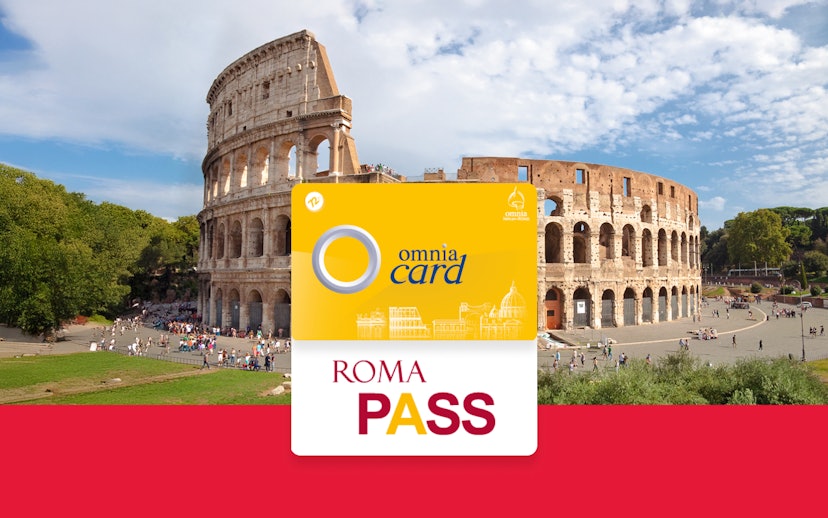
Omnia Card and Roma Pass: Access 10+ Attractions and Unlimited Public Transport | 72-hour pass + Vatican Museums & Sistine Chapel access + first 2 Roma Pass attractions free + discounted additional attractions + Hop-On Hop-Off bus + unlimited ATAC public transport | A packed Rome trip where you’re combining Ostia with Vatican and Colosseum-area sightseeing and want one pass to cover the heavy hitters. | €149 ↗ |
Choose standard Ostia Antica entry if you want a straightforward half-day ruins visit. Roma Pass or Omnia Card make more sense only if Ostia is one stop in a bigger Rome itinerary with enough extra sights and transit use to justify the pass.
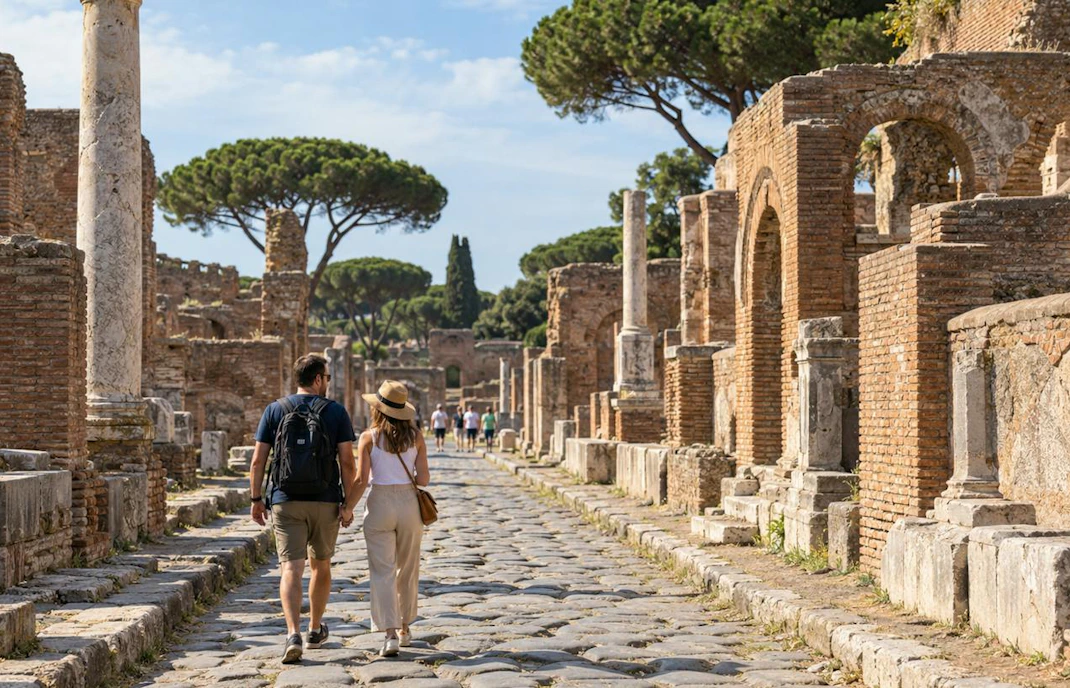
Ostia Antica is best explored on foot, and it’s large enough that a loose just-wander approach usually leads to backtracking. The main Decumanus Maximus acts as your spine, so once you understand that line, the site becomes much easier to read.


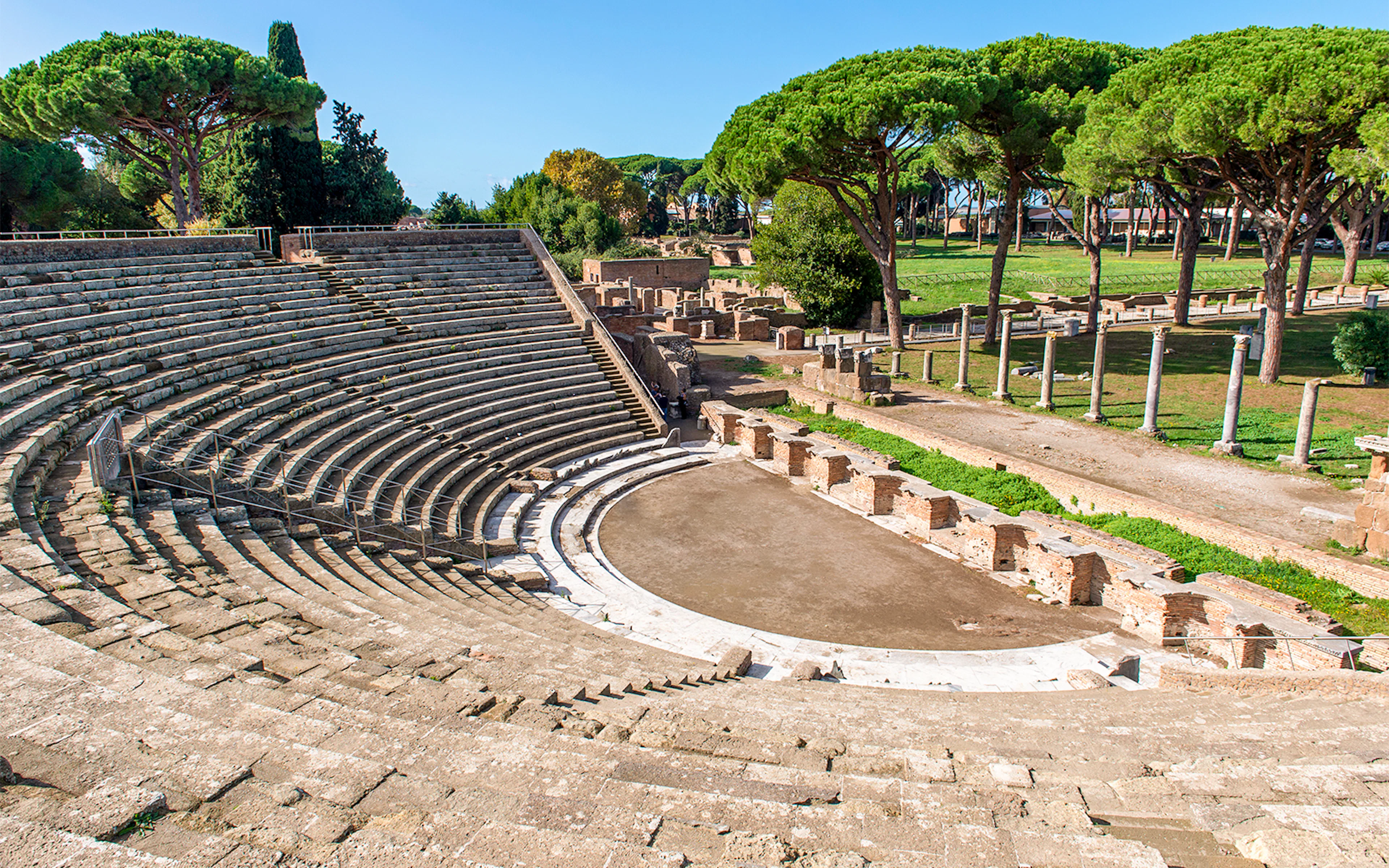
Type: Roman theater, late 1st century BC
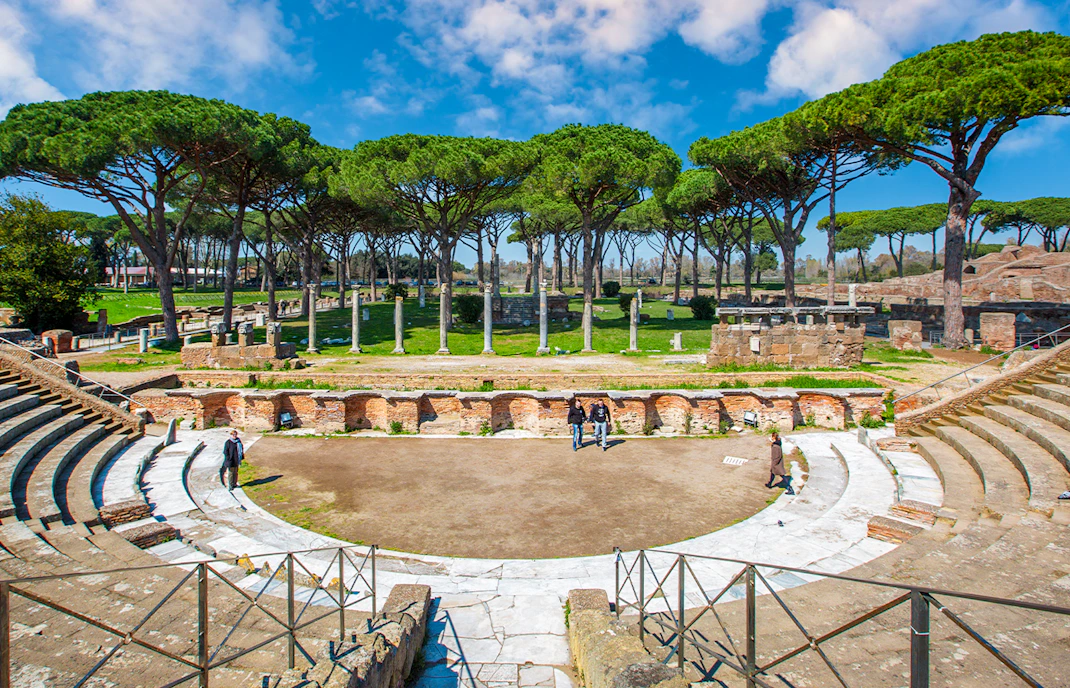
This is the stop that makes Ostia feel instantly alive. You can climb the restored seating, look back across the stage, and understand that this was not a remote outpost but a city built for a large population. What many visitors rush past is the view from the upper tiers: it frames both the stage and the merchant quarter beyond.
Where to find it: Along the Decumanus Maximus, before the forum area, beside the Square of the Guilds.
Type: Commercial plaza with merchant mosaics
Right behind the theater sits one of the smartest details in the whole site: a plaza ringed with offices used by traders from across the empire. The black-and-white floor mosaics work almost like ancient business signs, showing animals, ships, and cargo symbols. Most visitors notice the theater first and move on too quickly, missing how this square explains Ostia’s role as Rome’s working port.
Where to find it: Immediately behind the theater, on the raised square opening off the stage side.
Type: Public bath complex, Hadrianic–Antonine era
These baths are worth slowing down for even if you’re not normally a mosaic person. The famous Neptune floor is best understood from above, where the composition of sea horses, tridents, and marine figures finally reads as a full design. Many people glance at the rooms and move on, but the elevated viewpoint is the whole point here.
Where to find it: A short walk east of the theater, just off the Decumanus Maximus.
Type: Civic center and temple precinct
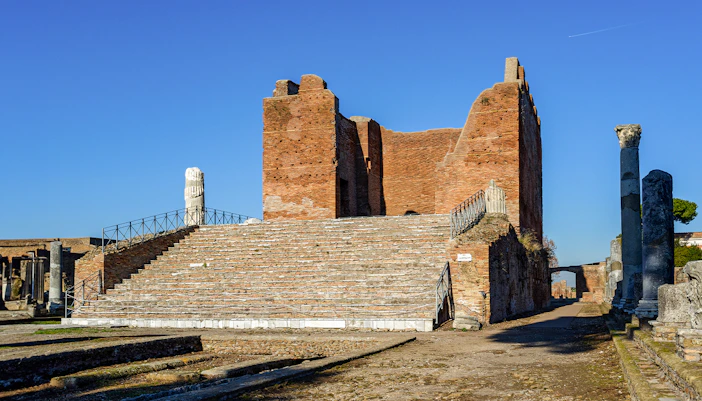
This is the heart of public Ostia — the place where politics, religion, and trade met. The open space can feel sparse at first, but once you clock the temple podium, basilica remains, and formal layout, it becomes much easier to picture the city’s original grandeur. Visitors often rush through because it seems emptier than the theater, but it’s the key to understanding how the whole city was organized.
Where to find it: Near the center of the site, farther along the Decumanus after the baths.
Type: Roman apartment block, 2nd century AD
If you want to understand how ordinary people lived here, this is the stop that changes the visit. The surviving lower levels show shopfronts, storage areas, and the shell of a multi-story apartment building that once held a dense residential population. Many people stay with the monuments and skip the insulae, but these blocks are what make Ostia feel like a real city rather than a ceremonial ruin.
Where to find it: Off the main route beyond the forum area, marked as Insula di Diana.
Type: Everyday infrastructure
This is one of the site’s most unexpectedly memorable stops because it says so much about Roman daily life in a single space. The row of marble seats makes Roman sanitation feel concrete rather than abstract, and it adds a very human detail after the grander temples and civic buildings. Visitors often pass it quickly because it looks functional rather than monumental, but that’s exactly why it’s revealing.
Where to find it: Near the Baths of Neptune complex, just off the main circulation area.
The Square of the Guilds is easy to miss because crowd flow naturally pulls you up into the theater seating and then back to the main road. Stay a few extra minutes behind the stage and you’ll get one of the clearest glimpses of Ostia as a working port city.
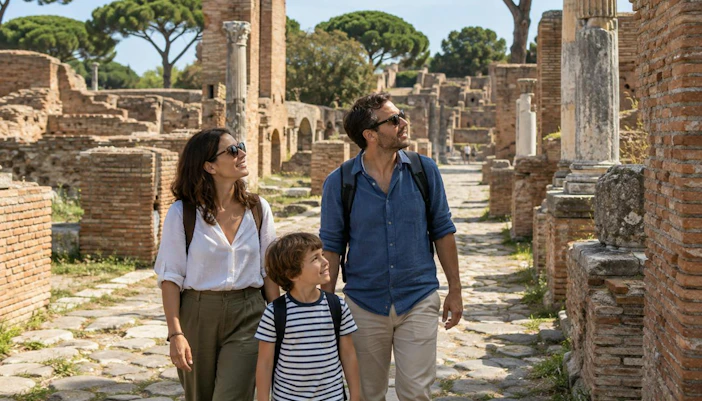
Ostia Antica works well for children who like space, movement, and stories, because it feels more like exploring a lost city than walking through a formal museum.
⚠️ Ostia Antica is best done in one continuous loop rather than a stop-start visit. If you step out for food or a break, you’ll lose time walking back from the entrance area and restarting the long route on uneven ground.
Staying near Ostia Antica only makes sense if you want a quieter base near the coast or you’re fitting the ruins around a Fiumicino airport stay. For most first-time Rome trips, it’s too far from the city’s main evening neighborhoods and classic sights to be your default base.
Most visits take 2–3 hours. If you like archaeology, photography, or slower walking, you could easily spend 4 hours because the site covers a long main route with enough side streets and residential blocks to reward a deeper look.
No, you usually don’t need to book far in advance for a normal weekday visit. Booking ahead is most useful on first Sundays, spring weekends, and Italian holidays, when more local visitors and day-trippers choose Ostia at the same time.
Arrive 15–20 minutes early if you’ve booked online. That gives you time to cross from the station, clear the entrance smoothly, and start before the sun and school-group traffic build up.
Yes, a small backpack is usually fine and is the most practical option for water, sunscreen, and a hat. Large luggage or hard rolling bags are a poor fit here because the walk is long and the paving is uneven.
Yes, personal photography is generally allowed across the open-air ruins. The main limit is preservation, so don’t cross barriers, climb onto structures, or step onto sensitive surfaces just to line up a shot.
Yes, Ostia works very well for groups because it has space to move without the pressure you get at more crowded Rome sites. The site is especially good for school groups, history groups, and families traveling together, as long as everyone is prepared for a few hours of walking.
Yes, especially for children who like space and exploration more than formal museums. The theater, bath complexes, and broad main street make it easier to keep kids engaged, and the calmer atmosphere is usually much less stressful than central Rome’s busiest ruins.
Partly, but not completely. The main route is easier than many side areas, and the electric shuttle helps with distance, but ancient paving, thresholds, and uneven surfaces still make parts of the site difficult for a wheelchair user or anyone with limited mobility.
Yes, there’s a café near the entrance and a few easy food options around the station and Borgo di Ostia Antica. If you want a better sit-down meal, it’s smarter to eat after your visit rather than interrupting the route midway.
The easiest route is Metro B to Piramide or Basilica San Paolo, then the Metromare train to Ostia Antica. From the station, it’s about a 5-minute walk over the pedestrian bridge to the entrance, and the whole trip from central Rome usually takes around 30–40 minutes.
Yes, if saving money matters more than atmosphere. No, if you want the calmest version of the site, because the first Sunday is free and attracts more local visitors, which makes Ostia feel noticeably busier than it normally does.
Ostia Antica sits southwest of central Rome beside Ostia Antica station, about 25km from the historic center and easy to reach on public transit.
Viale dei Romagnoli, 717, 00119 Rome, Italy
Ostia Antica has one main visitor entrance, and the only mistake people usually make is joining the ticket desk line when they already have their ticket ready.
When is it busiest? First Sundays, spring weekends, and mid-morning school-trip hours from April to June are the busiest, especially near the theater and Baths of Neptune.
When should you actually go? Tuesday to Thursday right after opening gives you cooler temperatures, lighter foot traffic, and more room to slow down in the forum and bath complexes.
💡 Pro tip: Don’t linger too long near the entrance buildings — head to the theater and Baths of Neptune first, then work your way back through the forum and residential blocks while you still have energy.
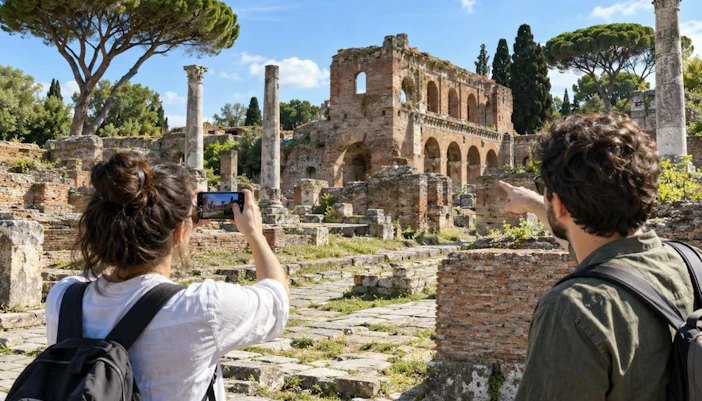
Personal photography is generally fine across the open-air site, and Ostia is one of the easier Roman archaeological parks for casual photos. The practical line is preservation: don’t cross barriers, don’t step onto sensitive surfaces for a shot, and assume that drones, tripods, and commercial filming setups need prior permission rather than spontaneous use on the day.
Distance: 350m — 5 min walk
Why people combine them: They sit right by the station and add a medieval layer to the same outing, so it’s the easiest extra stop before heading back to Rome.
Book / Learn more
Distance: 4km — about 10 min by train
Why people combine them: Ostia works well in the morning, and the beach or seafront lunch gives you an easy second half to the day without another long transfer.
Book / Learn more
Port of Trajan Archaeological Area
Distance: 12km — about 20 min by taxi
Worth knowing: If you want the maritime context behind Ostia, this is the logical next stop, but it works better for dedicated archaeology fans than casual visitors.
Isola Sacra Necropolis
Distance: 13km — about 20 min by taxi
Worth knowing: This burial complex is less famous but unusually atmospheric, and it pairs well if you want one quieter archaeological stop after the main site.
Inclusions #
Price Breakup:
Price: €12
Booking fee: €2
Inclusions #
Valid for 72 hours
Access to the first 2 attractions of your choice for free (with Roma Pass)
Discounted tickets for additional attractions (with Roma Pass)
Access to:
Museums: Vatican Museums & Sistine Chapel, Borghese Gallery, Capitoline Museums, Museo Nazionale Romano & more
Landmarks: Colosseum, Roman Forum, St. Peter’s Basilica & more
Bus tours & cruises: 72-hour hop-on hop-off bus tour (with Omnia Card)
Transportation: Buses, metro lines A, B, B1, C, and railway lines Roma-Lido, Roma Flaminio Piazza del Popolo-Viterbo, Roma-Giardinetti by ATAC
Validity:
Inclusions #
Valid for 48/72 hours (as per option selected)
Free entry to the first one or two attractions of your choice (as per option selected)
Discounted entry to all other attractions
Museums access: Capitoline Museums, Borghese Gallery, Ara Pacis, National Roman Museums & more
Landmarks access: Colosseum, Roman and Imperial Forums, Castel Sant'Angelo, Caracalla Baths & more
Transportation: Buses, metro lines A, B, B1, C, and railway lines Roma-Lido, Roma Flaminio Piazza del Popolo-Viterbo, Roma-Giardinetti by ATAC
Get all the details here
Validity: